


Analysis
A facility can retain “refinery” in its name, appear in a fuel-tax register and have an active environmental case after its crude-processing equipment stops operating. These statements concern different attributes. Treating them as interchangeable creates false refinery counts, misleading capacity comparisons and incorrect links between wells and downstream infrastructure.
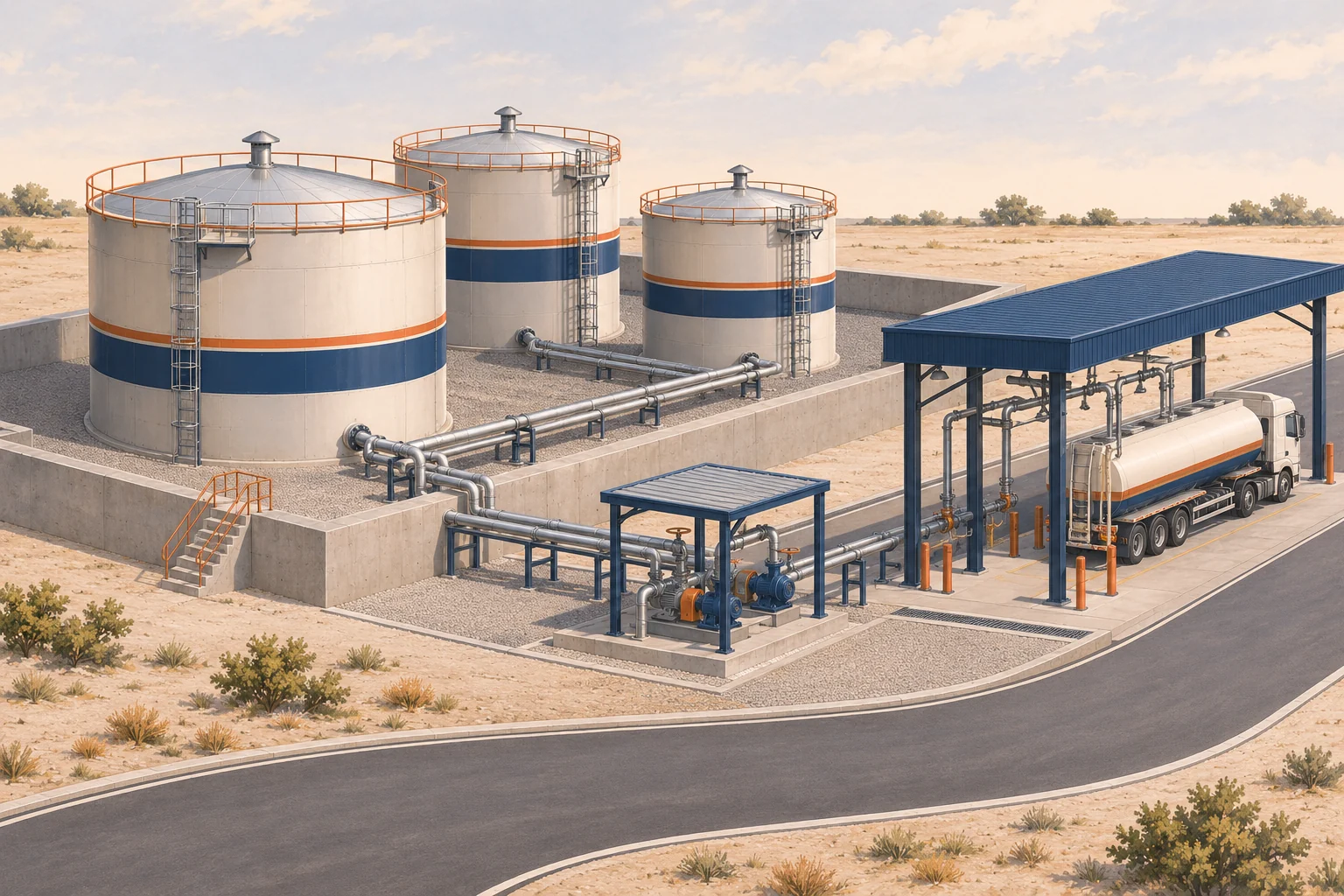
This engineering review separates process identity, site identity, operating observations and reporting dates. It uses official documents and operator descriptions checked on 11 November 2026. The tank example is explicitly hypothetical, and the illustration depicts an unnamed conceptual terminal. Neither supplies measurements for any named facility. The corresponding reviewed Atlas records preserve their source history and unknown operating-state fields.
Define the process before counting the plant
Start with what crosses the process boundary. Crude distillation, condensate fractionation, asphalt blending and fuel storage can all involve tanks, heaters, pumps and petroleum products, but those shared features do not establish the same industrial activity. A product list is insufficient: asphalt can come from a crude refinery or be received and blended at a terminal. Petro Rabigh explicitly identifies Arabian Light crude as feed; its integrated petrochemical activity does not erase the refining function. Conversely, a distribution business does not gain crude-processing capacity because its company name contains “oil.” Record the documented feed and process separately from ownership, current availability and any numerical rating.
Read the purpose of each register
The IRS document headed Active Fuel Refineries, dated 30 August 2026, is a fuel-tax registration inventory. It includes Hunt Southland at Lumberton and North Pole Refinery, as well as separately named renewable-fuel facilities. Its title must not be treated as an engineering definition of operating atmospheric crude distillation. Read the address and registration context, then examine plant-specific process evidence. The separate IRS terminal inventory is also a registration source; appearing in both inventories need not imply two physical installations. Deduplicate only with documented identity evidence. A tax record, environmental permit and operator page answer different questions, and disagreement between their labels requires review rather than automatic replacement of one field by another.
North Pole: an active case is not an active crude unit
Alaska DEC’s North Pole page, with a summary updated on 1 May 2026, describes the former Flint Hills refinery as the Marathon Terminal and dates the end of refining to 2014. The page’s Active field belongs to its contaminated-sites record. It therefore describes an environmental case, not verified current crude-unit operation. The same source separates historical activity from ongoing groundwater work. This review uses the explicit terminal reuse to correct the activity class while preserving unknown operating status in the dataset. The nearby Petro Star refinery has a separate IRS entry and address; its activity cannot be transferred to the former Flint Hills record merely because both are in North Pole.
Lumberton and Tryon: storage and dispatch are distinct activities
Hunt’s own logistics page identifies the Lumberton Terminal as manufacturing emulsified asphalt and storing and dispatching paving-grade asphalt. Its contact page places the site at 7539 Highway 11, matching the retained map address and distinguishing it from Sandersville and Tuscaloosa. These positive process descriptions support the terminal class despite the older refinery naming. Neal Oil describes bulk propane, diesel and gasoline distribution in Tryon. The county hazard plan lists its fixed chemical-storage locations using a 2020 inventory; the document itself is dated 2021 despite a 2026 download path. Such historical storage evidence is not a current compliance certificate. Loading counts and tank capacities remain their own quantities.
Bakersfield: match the street and the well function
EPA’s SJR draft Class I injection-permit fact sheet describes heavy-crude-derived manufacture at Shell Street in northern Bakersfield. It identifies WD-1 as a wastewater-disposal well and gives a refinery-site location. The IRS inventory separately lists San Joaquin Refining at 3542 Shell Street and Central Valley Renewable Fuels at 6451 Rosedale Highway. A conversion at the second location cannot be assigned to the first solely through a city-name match. Similarly, the disposal well is not an oil-production observation. The draft describes proposed permit conditions and a proposed additional well; it does not by itself prove that those conditions became final or that a future well was drilled. No verified Well Atlas production-record join has been established here, so none is invented.
Calculate inventory cover without creating refinery capacity
Assume a hypothetical usable inventory V = 24,000 bbl, expressed on the same liquid-volume reference basis as a constant dispatch rate Q. The ratio τ = V/Q has units of days. At 3,000, 6,000 and 12,000 bbl/day, it gives 8, 4 and 2 days respectively; the chart reproduces these three calculations. For a no-inflow, constant-outflow example, dV/dt = −Q and the time to exhaust that usable inventory is V/Q. With replenishment, the same ratio is only nominal inventory cover, not a stockout forecast or a measured residence-time distribution. Tank heels, unavailable product, line fill and operating reserves must already be excluded from usable inventory. All three dispatch rates are assumed scenarios, not plant observations. Neither the inventory in barrels nor its ratio to dispatch is crude-distillation nameplate capacity.
Keep annual feed, projects and present availability apart
Uzbekneftegaz’s May 2025 offering circular describes Bukhara’s mixed oil-and-condensate processing. The government’s 4 November 2026 account locates it in Karaulbazar and describes proposed hydrotreating, isomerisation and expansion. The location and feed evidence support refinery identity, but a planned expansion is not a completed process unit. An annual mass rating needs a documented feed-density and time basis before comparison with daily liquid volume; condensate and crude must retain their declared scope. The linked capacity and API-gravity guides show those separate calculations. A dated production announcement likewise remains an observation for its stated date, rather than a guarantee of uninterrupted operation on every subsequent day.
Build connections that the evidence can support
A reproducible facility review retains the map ID, source URL, document date, access date, process description and reason for the decision. Keep earlier classifications in revision history. Link the reviewed facility record and relevant engineering explanation directly, while labelling unverified joins as unresolved. An operator’s portfolio is not proof of a physical supply route, and a shared town is not proof of a common plant. This seven-record review retains every existing facility ID and leaves capacities and operating states unchanged. It reduces uncertainty about activity classification, without turning that narrower improvement into new production, ownership or supply-chain claims. Reassessment remains necessary when dated plant-specific evidence changes. A retained source record identifies a documented map feature; it does not certify a surveyed physical boundary.